


As ever the summer months defied their stereotype and provided a huge amount for investors to digest. On the whole, they also proved to be a good period for investing. We take this opportunity to reflect on the recent strength in equity markets and the key factors underpinning our belief that this can continue. We also discuss the continuing selloff in government bonds which has accelerated in the last three months, before turning to some key political developments.
The healthy performance of equity markets so far this year has been predominantly driven by robust corporate earnings growth. In fact, at the time of writing, analysts expect earnings across the S&P 500 index of US companies to have grown 31% year-on-year by the end of December, significantly outpacing the share price gains of the US market over the year to date. We discussed the breadth of corporate profit growth in our update last quarter, with particular reference to Asian markets, but the story has been widespread. Consensus estimates published by JP Morgan suggest that all major developed equity markets will see earnings growth of >10% in 2026. This leaves most markets trading at lower price-to-earnings multiples today than at the start of the year, albeit in some cases still above historic averages. It is important to keep in mind that, all else equal, strong earnings growth commands a higher valuation. Ultimately, participating in earnings growth is the fundamental point of investing in equities for the long term.
Large, developed economies are in aggregate showing steady growth, with unemployment relatively low and the corporate sector maintaining its profit margins despite some price pressures. The overall picture obscures a much more nuanced reality, with interest rate sensitive sectors such as property struggling under higher borrowing costs. Consumer sentiment is also subdued in the face of persistently rising prices, mainly among low-income households. By contrast, sectors exposed to the build out of Artificial Intelligence are booming. Technology is the most obvious example, but companies in the financial and industrial sectors have also been revising earnings higher this year. Higher energy prices have also boosted profits for related equities. With leading indicators of economic activity looking relatively positive, we see the supportive environment for equities continuing for the time being.
In contrast to equities, bonds are on track for their fifth consecutive year of declines, with the weakness, characterised by rising yields, intensifying recently. At the end of the quarter, the benchmark 10-year US Treasury yield stood at 5.28%, the highest since 2002 for this particular maturity and nearly 1% higher than the start of the year.
US 10-Year Treasury Yield
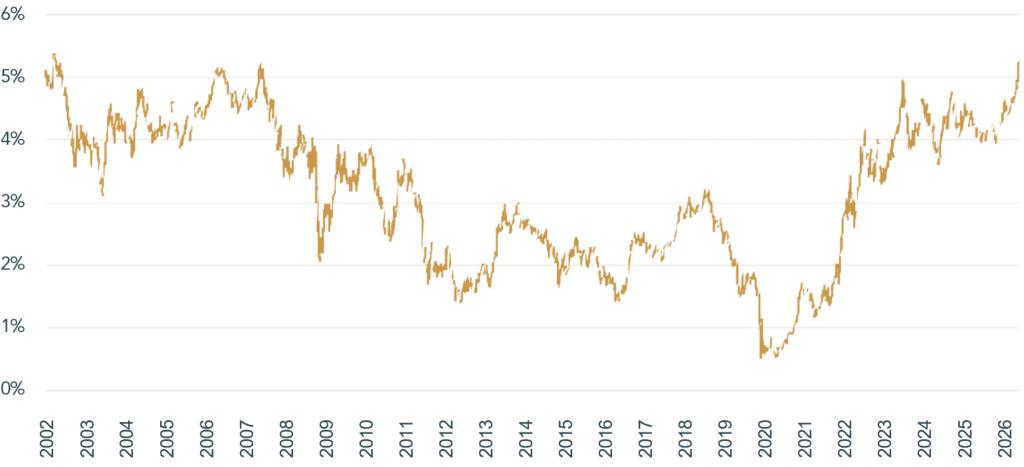
The historical context of this repricing is shown in the graph above. The cause of this phenomenon in yields, evident in most major economies with the notable exception of China, is the subject of some debate. Popular narratives include concerns over unsustainable budget deficits in the US and elsewhere, as well as concerns that central banks will be unable to contain inflation, which has reaccelerated recently. Whilst we are careful not to dismiss these two important factors in bond pricing, we would emphasise a key third factor in play.
We know from the differential in inflation-linked and fixed-coupon bonds that the market’s long-term inflation expectations have remained largely unchanged over recent years, despite spikes in near term inflation. We also know that the term premium has remained stable – this is the incremental yield the market demands as compensation for lending over longer periods of time. If investors were becoming meaningfully concerned that their bonds might not be repaid, you would expect this to have risen more. The third, and in our mind most important, factor driving the rise in yields is short-term interest rate expectations over the next 10 years. We would argue the market has essentially been recalibrating to a world in which short term interest rates stay at and around current levels for an extended period, lifting yields across all maturities of government bonds.
This repricing has been painful for holders of traditional longer-dated government bonds. Whilst not immune, our portfolios have been somewhat sheltered from these capital losses given our preference for shorter-dated instruments in our government bond allocation. With a shorter time to maturity, these bonds are less sensitive to changes in longer-dated yields. We maintain this shorter duration stance in government bonds for now, although we are mindful that with yields on the highest quality government debt over 5%, longer-dated bonds are becoming relevant to the construction of diversified portfolios for the first time in over a decade.
Although longer term inflation expectations have not moved a great deal, the near-term picture has evolved significantly in the past few months. A combination of war in the Middle East, restricting the supply of oil and gas, coupled with damage to refinery infrastructure in both the Middle East and Russia, has caused energy prices to rise sharply, particularly those of refined products like petrol and diesel. Consumers are quite literally paying the price at the pump, with US diesel prices at all-time highs and UK prices close to the previous record in 2022. With no clear path to de-escalation in either conflict, it looks as though consumers will be forced to absorb this budgetary pressure for the foreseeable future, although both situations are evolving rapidly and there are certainly plausible incentives on both sides to de-escalate in the Gulf.
Energy prices are playing an increasingly critical role in US politics, with the US midterm elections due to take place on 3rd November. The prospect of a so-called “blue wave”, in which the Democrats take control of the House of Representatives and the Senate, is becoming increasingly probable. Midterms have historically been unkind to the sitting president’s party, so some erosion of Republican power would not be surprising, although a clean sweep of both chambers would be significant in shaping policy focus in the 2028 presidential election. Equities have historically performed well under divided government in the US, as gridlock within the machinery of US government typically limits policy change, which tends to be welcomed by equity markets. A Congress less aligned with the White House would likely act as a brake on the more aggressive elements of the current agenda. As ever, we refrain from positioning portfolios around a single political event.
That said, we do watch for sustained political trends that could have long-term economic consequences. The Alternative for Germany (AfD) victory in the Saxony-Anhalt state election in September is a potentially noteworthy development in this regard. The far-right party won 43.8% of the vote, its strongest ever result in a German state election. Chancellor Merz’s Christian Democratic Union party recorded its worst ever result of just 17.2%. With no outright majority and no other party willing to co-operate with it, the AfD does not yet wield power in eastern Germany. However, its advocacy for strict fiscal conservatism casts the beginnings of some doubt over the large spending packages on infrastructure and defence proposed under the current government. Any dilution of this policy would not be welcomed by markets, although the headwind could be offset by the party’s support for tax cuts and cheap energy, achieved by lifting sanctions on Russian supply and expanding nuclear power. It is too early to draw investment conclusions, but significant enough to take note.
In the face of political uncertainty, not least in the UK where we await the first budget under Prime Minister Burnham, we are comforted by the fact that equity markets have broadly rewarded fundamentals so far this year. By focusing our exposure on fairly priced companies, particularly via our active fund managers, we improve our margin of safety and give the underlying business model the best chance of driving returns. With emerging markets leading the way in terms of performance this year, we are also reminded of the power of both a global investment strategy and genuine diversification, including being thoughtful about the role bonds play within a portfolio. This structural starting point stands us in good stead to harvest the compounding returns on offer for those investing for the long term.

Fred Hervey
Chief Investment Officer